


Call us now
08071793640
CK-MB (Liquid)
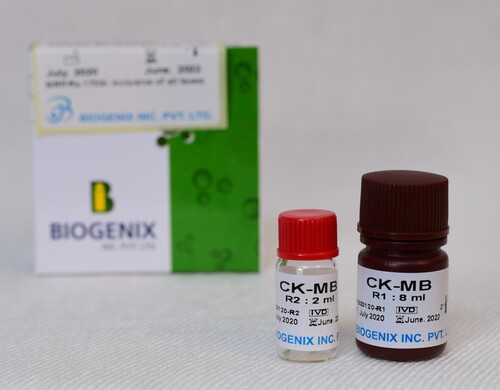

CK-MB (Liquid) Trade Information
- Minimum Order Quantity
- 1000 Milliliters
- Sample Policy
- If order is confirmed we will reimburse the sample cost
- Main Domestic Market
- All India
About CK-MB (Liquid)
Human CK-MB is composed of two subunits, CK-M and CK-B which both have
an active site. With the aid of specific antibodies to CK-M, the catalytic activity
of CK-M subunits in the sample is inhibited to 99.6 % without affecting the
CK-B subunits. The remaining CK-B activity, corresponding to half the CK-MB
activity, is determined by the total CK method. As the CK-BB isoenzyme
only rarely appears in serum and the catalytic activity of the CK-M and CK-B
subunits hardly differ, the catalytic activity of the CK-MB isoenzyme can be
calculated from the measured CK-B activity by multiplying the result by 2.
Ready-to-Use, Hassle-Free Detection
CK-MB (Liquid) eliminates preparation complexity by providing a single liquid reagent, ready for direct application. Theres no need for time-consuming calibrations, allowing for straightforward workflow integration in both high-throughput and low-volume laboratories. This simplicity ensures consistency and saves valuable technician time.
Reliable and Versatile Performance
The assays compatibility with all semi-automatic and fully automatic analyzers makes it suitable for a broad range of laboratory environments. Utilizing the IFCC-approved enzymatic UV kinetic method, it delivers results with high specificity and accuracy across diverse clinical settings.
Extended Shelf Life and Stable Storage
With an 18-month shelf life from the manufacturing date and stability assured at 2C 8C, CK-MB (Liquid) minimizes reagent wastage. This makes it an economical choice for laboratories needing reliable, long-lasting reagents for cardiac marker testing.
FAQs of CK-MB (Liquid):
Q: How is the CK-MB (Liquid) reagent used for CK-MB determination?
A: Simply add 20 L of serum or plasma sample to the reaction mixture as instructed. Incubate at 37C for 5 minutes, and the reagent will measure CK-MB activity using the UV kinetic method as per IFCC guidelines.Q: What advantages does the single liquid, ready-to-use format offer?
A: This format removes the need for reagent preparation or calibration, saving time and reducing the possibility of errors, while streamlining the testing process for laboratory staff.Q: When should the CK-MB (Liquid) reagent be used in the diagnostic process?
A: CK-MB (Liquid) should be used when a quantitative determination of CK-MB enzyme activity is needed, typically in the evaluation of suspected myocardial injury in clinical diagnostics.Q: Where should this reagent be stored, and how long is it stable?
A: Store CK-MB (Liquid) at a temperature between 2C and 8C. The reagent remains stable and effective for up to 18 months from the date of manufacturing, when stored as directed.Q: What sample and reaction volumes are required for analysis?
A: The method requires a sample volume of just 20 L and a total reaction volume of 1000 L for each determination.Q: Is this reagent compatible with all clinical laboratory analyzers?
A: Yes, CK-MB (Liquid) is designed for seamless use with both semi-automatic and fully automatic analyzers, offering flexible application across various laboratory platforms.Q: What benefits does this assay method provide to laboratories?
A: It offers fast turnaround times (results in 5 minutes), no requirement for calibration with ready-to-use packs, and reliable quantitative analysis, improving efficiency and ensuring accuracy in cardiac diagnostics.Tell us about your requirement

Price:
Quantity
Select Unit
- 50
- 100
- 200
- 250
- 500
- 1000+
Additional detail
Mobile number
Email

More Products in Clinical Biochemistry Kit Category

GST : 09AAGCB6941G1ZJ

B19/A , S.I.L Ancillary Estate Amausi Industrial Area, Nadarganj,Lucknow - 226008, Uttar Pradesh, India
Phone :08071793640
 Send Inquiry
 Send Inquiry
 Send SMS
BIOGENIX INC. PVT. LTD.
All Rights Reserved.(Terms of Use)
Developed and Managed by Infocom Network Private Limited.
Developed and Managed by Infocom Network Private Limited.

